Employee Retention Credit (ERC) and Self-Insured Medical Reimbursement Plan (SIMRP)!
Two Different Programs. One Common Goal: Supporting Employers and Employees.
How ERC Helped Employers and Employees
The Employee Retention Credit helped businesses withstand an extraordinary period of disruption while continuing to support the people who depended on them.
Employees Benefited
Greater Job Security The credit helped employers retain workers who might otherwise have faced layoffs or reduced employment.
Continued Access to Workplace Benefits Remaining employed helped many workers maintain employer-sponsored health coverage and other important benefits.
Less Financial and Career Disruption Employees were better able to preserve their income, work history, and connection to their employer during an uncertain period.
Employers Benefited
Meaningful Payroll Tax Relief Eligible employers received refundable payroll tax credits that helped offset a portion of qualifying wages and healthcare costs.
Preservation of an Experienced Workforce Employers were better positioned to retain trained employees rather than lose valuable talent and later incur rehiring and retraining costs.
Stronger Position for Recovery The financial relief helped organizations stabilize operations and respond more effectively as economic conditions improved.
How SIMRP Helps Employers and Employees
How Employees Benefit
Increases take-home pay.
Provides access to qualified medical and wellness benefits.
Works alongside existing health insurance coverage.
Has zero net cost.
How Employers Benefit
Reduces payroll-related costs.
Provides greater flexibility to enhance benefits without replacing existing health insurance.
Requires minimal ongoing internal administration.
Improves employee recruitment and retention.
What ERC and
SIMRP Have in
Common
Both create value for employers.
Both create value for employees.
Both operate within federal tax frameworks.
Both demonstrate how government-authorized programs can support employers and employees.
One-Time Benefit. Ongoing Opportunity
ERC
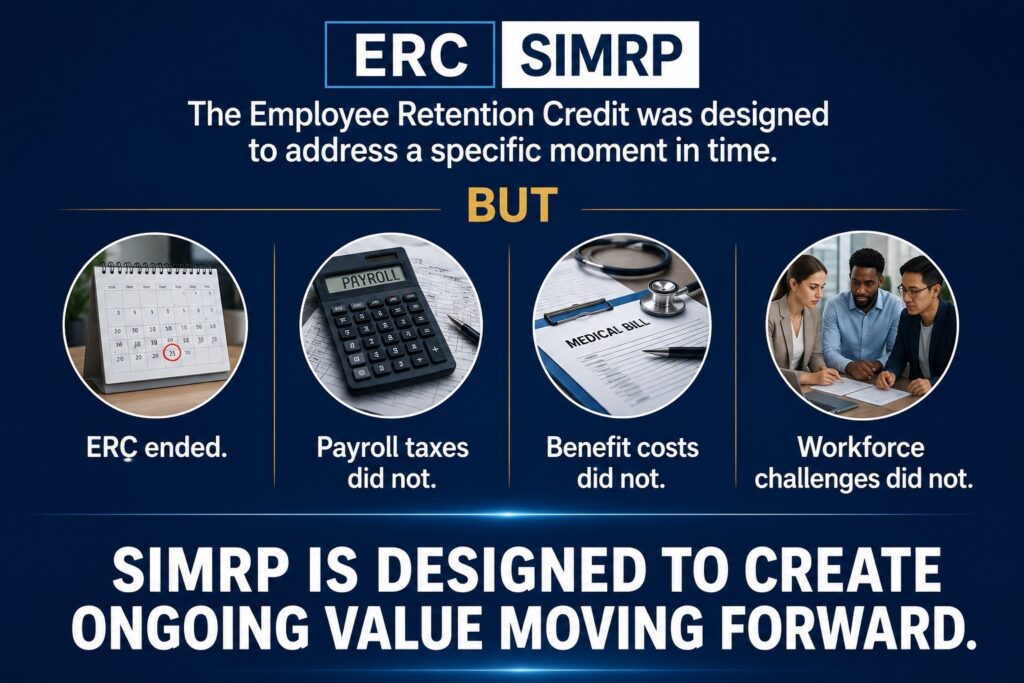
The Employee Retention Credit was designed to address a specific moment in time. SIMRP is designed to create ongoing value moving forward.
ERC ended.
Payroll taxes did not.
Benefit costs did not.
Workforce challenges did not.
One More Important Similarity
When employers received ERC funds, the government generally did not tell them how to spend the money. The employer decided.
SIMRP works much the same way. The savings belong to the company. The company decides what to do with them.